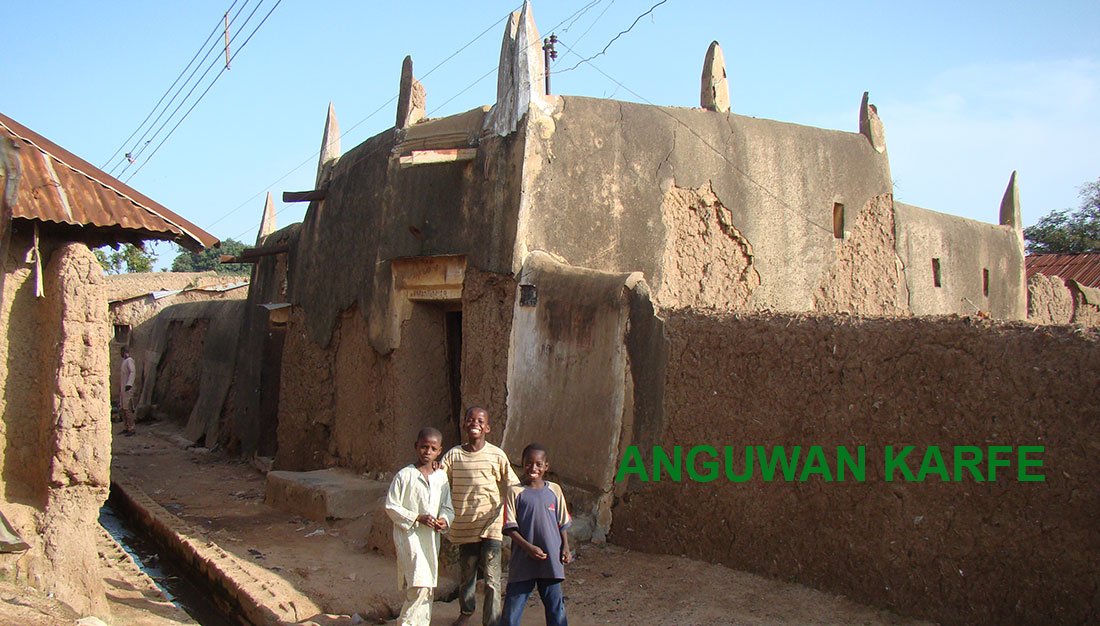
Anguwan Karfe is situated to the northeast of Jakara stream on a fertile Fadama. The location of this ward on such a favourable geographical location tends to suggest that the area must have attracted human population at a very early period. This seemed to be supported by the discovery of a large number of abandoned dye pits numbering over one hundred on the site. Even though the antiquity of these dye pits is not known, they appeared to be of ancient origin and they seemed to indicate the existence of a prosperous community with an economy based on agriculture and dyeing activities probably dating to the period before the emergence of centralized political institutions in Zaria.
Whatever the antiquity of Anguwan Karfe, it appears that two dominant occupational groups emerged at an early period following the formation of the Birni. These groups were: blacksmiths and butchers. Little is known about the genealogy of these occupational groups. This ward must have therefore played a very important role in the city by providing its inhabitants with all their military and household needs in terms of weapons and other implements, while the butchers provided the protein needs of the society.
A very important development leading to the transformation of this quarter into a ward was the settlement of large group of Sullubawa in the site. This group of people were said to have migrated from the Sokoto- Rima basin into the ward around the middle of the 18th century. The most prominent figure among this people was Malam Ja’e. According to local tradition Malam Ja’e was rich possessing large herds of cattle numbering several thousands. It was stated further that the settlement of Malam Ja’e in the quarter led to its transformation into an important economic centre, which resulted in the establishment of the Zaria Market near it. The lineage of the Sullubawa residing within Anguwan Karfe was reported to have supported the Jihadists against the last Habe King of Zazzau, Muhammadu Makau (1806-1808). A. D.