
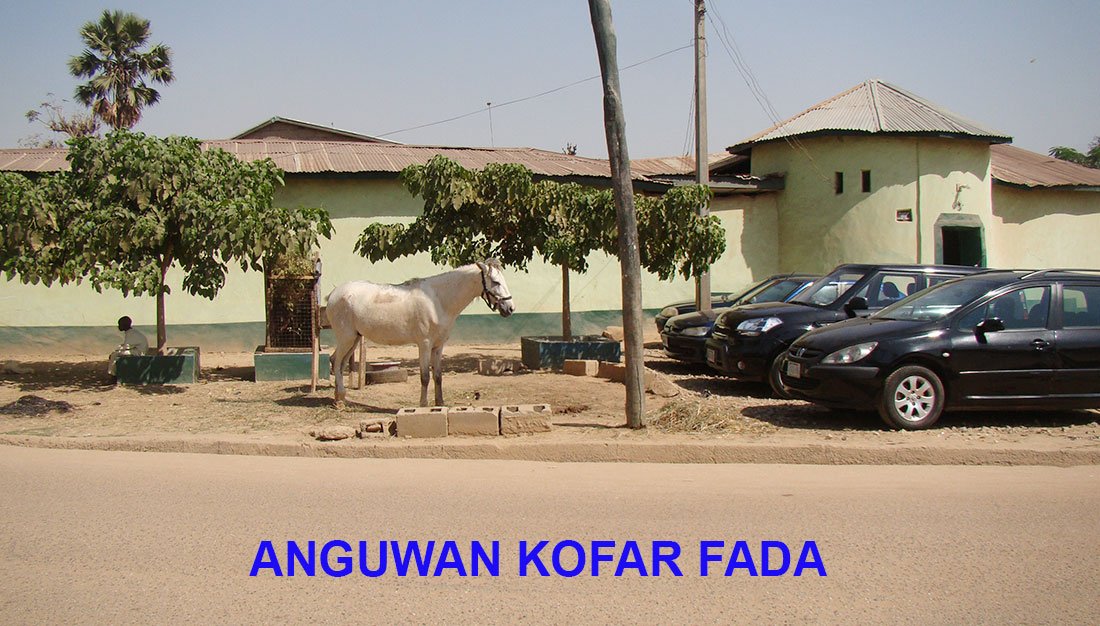
As the name implies, Kofar Fada is used to refer to the wide open-space that initially separated the Palace from the rest of the other wards in the walled city but which was gradually filled up by buildings. It should however, be noted that Kofar Fada is strategically located between the earliest centres of human settlements on the Zaria plains namely Madarkachi and Fadamar Bono. This suggests that the area around the Kofar Fada was under continuous human habitation since ancient times. Therefore the identification of the ward with the name Kofar Fada must be later probably following the construction of the Palace on the area.
The extent of Kofar Fada by the late 18th century included part of Madaka, Kakaki, Albarkawa, Bambale and some parts of Kwarbai. Now the whole of the area formally designated as Kofar Fada has been heavily congested with several compounds, leaving only small open space.
However, before the end of the 18th century only three large compounds towered above all other compounds in the whole of this area that later formed the nucleus around which the present wards of Kakaki, Bambale and Jamawa emerged. For instance, Jamawa was made up of a single big compound belonging to Magajiya, one of the daughters of Bakwa, the King of Zazzau. This hitherto big compound is now broken into several independent houses. Other houses were gradually built around it. Soon the place developed into a ward named after the founder of the large compound in the area called Jamawa.
The founder of Bambale, Malam Salihu was said to have come to Zaria in the company of Malam Musa the leader of the Jihad of 1808 in Zaria. Following the success of the Jihad, the need for the resettlement of those that came with the leaders of the Jihad arose. Consequently, Malam Salihu was among those that were settled close to the Palace. This was in recognition of his status as a Scholar.
The compound that was given to Malam Salihu is located at the place that is presently called “Makaranta” where the lineage of Malam Ahmad Baban Kauna and Malam Ibrahim Kwaire are presently living. After settling in the compound he started teaching. The house was to emerge as a centre of learning. It was because of the extent of the academic acumen of Malam Salihu and the calibre of his pupils who were mostly, made up of princes and children of the well to do that the centre earned the name ”Makarantar Bambale.’’ It was from this name that the ward derived its name. Apart from the lineage of Malam Salihu, there was also the lineage of a butcher.
Another prominent lineage that lived in Kakaki was the lineage of Malam Ibrahim Tsoho. He was said to have been of Bornoan extraction. The circumstance leading to his coming to Zaria was influenced by the Jihad of Usman Dan Fodio when the Habe rulers were expelled from Zaria. Following this development Makau on his plight took refuge with the chief of Kajuru. After a while, the Habe ruler of Zazzau, Makau left Kajuru for Abuja where he established a kingdom. Mean while, Albarka a prince of the Habe rulers of Zazzau was already resident at Kajuru as the representative of the Madakin Zazzau who was the Hakimi of the area. When Makau left for Abuja, Albarka remained at Kajuru. There was a great scholar who had been living in the area teaching and preaching long before the Jihad whose name was Abduljalil.
Already Albarka had found Malam Abduljalil a close ally and a teacher. When Albarka therefore decided to return to Zaria he sought the company of Abduljalil so that when he reached Zaria he might through his influence get acceptance from the new administration at Zaria. However, Abduljalil declined to follow him on account of old age and instead instructed his son Ibrahim Tsoho to follow him.
On reaching Zaria they were accepted and accommodated. Abubakar was given a house close to the palace. The house is now inhabited by the lineage of Malam Aminu Gadina (behind Na’ibi’s house), while Ibrahim Tsoho was accommodated in a section of the house. It was therefore from Albarka that the Albarkawa ward derived its name.
Later Malam Tsoho was given a land north of Albarka’s house to build his own house close to gidan masu kakaki, which is located close to Albarkawa. It was the presence of masu kakaki that the ward came to assume the name kakaki. Seventy percent of the people living in Kakaki were descendants of Malam Ibrahim Tsoho. Soon the compound of Ibrahim Tsoho became a great centre of Islamic learning which attracted lot of people from far and near.