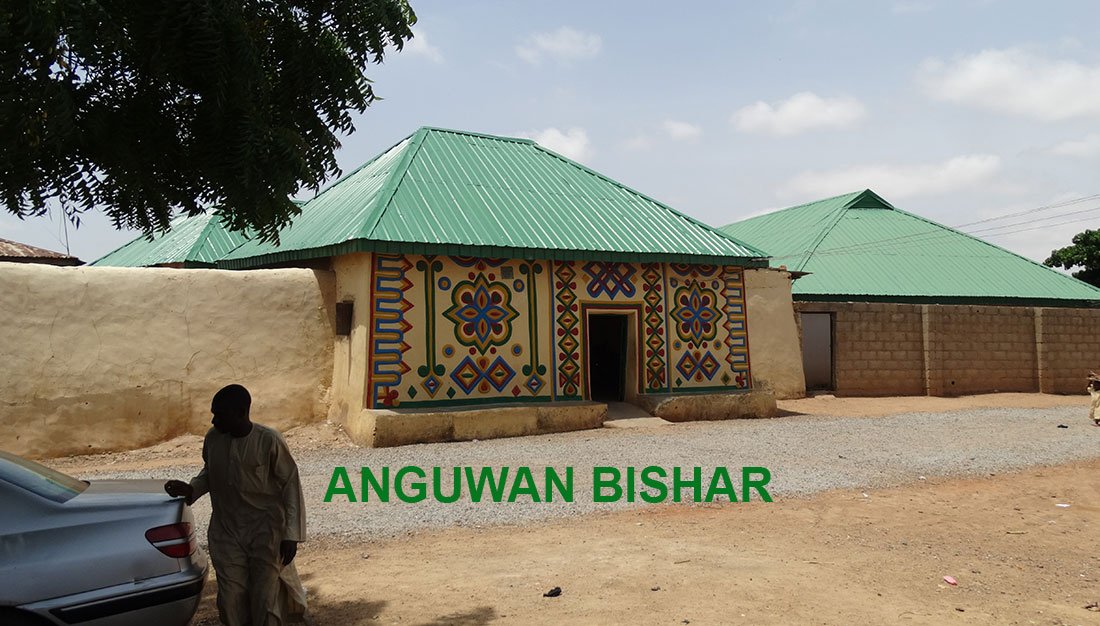
Anguwan Bishar is situated on a fertile land along the Rafin Sarkin, which started up from the site of Babban Dodo and passing through Anguwan Bishar joining up with the Saye River, a tributary of River Galma.
Anguwan Bishar bears its name from a spirit (aljana), which is believed to be still in existence. It was stated that whenever the aljana was hard pressed it would say “Bishar” and disappeared immediately. It was from this expression that the ward got its name.
We do not know precisely when the ward of Bishar was formed. This is because no tradition has survived of any earlier settlement on the site. However in view of the association of the name of the ward to a spirit which formed part of the ancient belief of the people of Zaria, combined with the fertility of the land and its location close to two gates namely Kofar Gayan and Kofar Kona, it is possible that the ward was inhabited as early as the establishment of the Birni.

However the local tradition of the people maintain that Anguwan Bishar was formed following the mass influx of large group of Fulani pastorals of the Sullubawa clan under the leadership of Muhammmadu Kayi into the ward. The local tradition explained further that the Sullubawa moved from Yandato to Zaria around the 18th century. And that following his arrival to Birnin Zaria Malam Muhammadu Kayi settled first in the compound of Limamin Kona before moving to this ward after getting a piece of land in the area from the King of Zazzau where he settled his family and his large retinue of slaves and servants. The tradition stated further that the area given to Malam Muhammad Kayi was inadequate to graze his cattle. Consequently, he had to settle part of his followers at Anguwan Lalle while some settled at the nearby town of Kwagoro. Still some were settled further at Gwaza Toka, which was an area situated between Saye and the city. There was some also at Yeskwake at the outskirts of the Birni and a large number of his servants, slaves and cattle also resided at Igabi. The tradition also suggests that Anguwan Bishar emerged as an important centre of economic activities following the activities of Malam Muhammadu Kayi’s servants who specialized in dukanchi (leather works).
Two other groups of pastorals were also identified to have settled in this ward. One of these groups was the lineage of Wanya Adamu and Magaji Sambo. This group were believed to have belonged to the Toronkawa group of pastorals and that their movement into the Birni from Aba in 1806 was due to several attempts by the Jukuns to loot their cattle. The other group was the lineage of Malam Sambo who also belonged to the Toronkawa pastoralist. He was said to have come from the Sokoto area by the beginning of the 19th century. He was also a great scholar. It was on account of this that Abdussalam; one of the Emirs of Zazzau gave him his daughter in marriage. These three groups of pastoralists were believed to have actively participated during the Jihad in 1808 in Zaria.