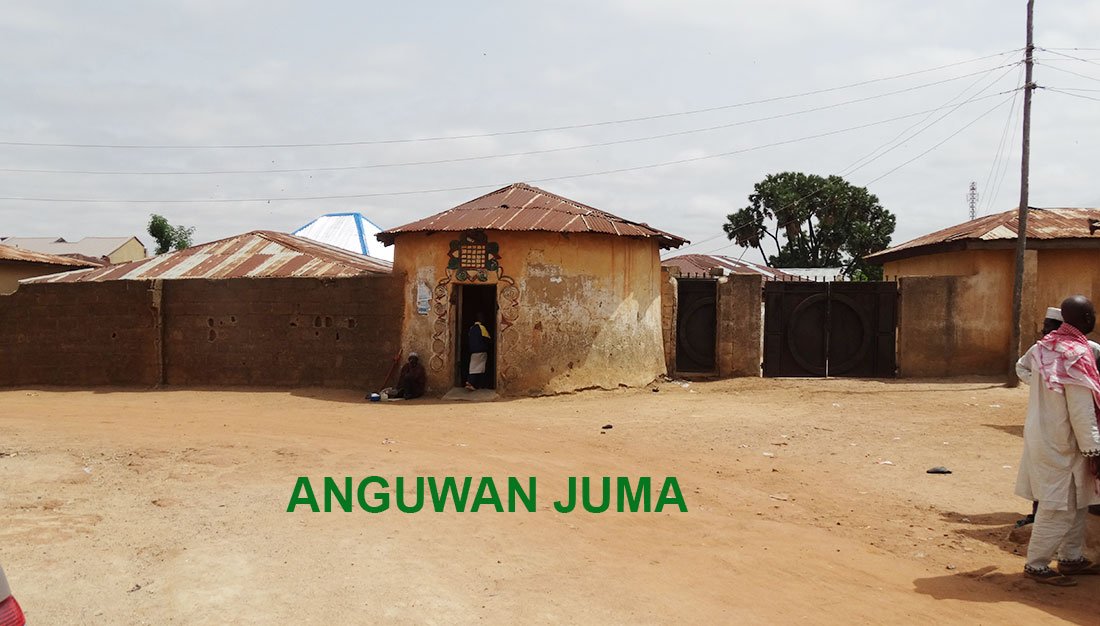
Juma ward is situated on a high land, dotted by rocky outcrops and ferruginous ironstone along the Kamacha stream south of Salmanduna. The habitation of the site appeared to be of long antiquity dating back to the beginning of permanent settlement on the Zaria plains. The establishment of the ancient market of Durumin Maigarke, which was located near the site of Anguwan Juma, seemed to be an important consideration in the evolution of Juma ward. The economic activities in the ancient Market of Durumin Maigarke seemed to serve as a pull-factor, drawing particularly Moslem traders and Merchants to the area like a magnet. This consequently, led to the rapid transformation of the settlement of Anguwan Juma into a major centre of human population. It was through the activities of Moslem scholars and traders within Anguwan Juma and its environs that consequently led to the expansion of the Muslim population on the Zaria plains, a development that necessitated the construction of the earliest Juma’a Mosque (Friday prayer Mosque). The construction of the Mosque was dated to the period of the reign of Muhammadu Rabbo (1456-1481). It is possible that the ward bore a different name in the past but the establishment of the Juma’a Mosque made people to refer to the site as Anguwan Juma.
Among the prominent groups in Anguwan Juma were the Malaman Juma who traced their ancestry to Malam Abubakar who is believed to have come from Futa Toro. We do not know what informed the decision of Malam Abubakar to leave Futa Toro. But this may not be unconnected with the political instability that characterized most societies in the western and central Sudan. Having left Futa Toro he had a short spell at Yandoto, Katsina and Borno before he permanently settled in Zaria with his large retinue of family, students and cattle. By the middle of the sixteen-century Malam Abubakar emerged as the chief Imam of the Juma’a Mosque. He was subsequently succeeded to the Imam-ship position by three of his descendants. Thus, by the period of the outbreak of Jihad in Zaria in the nineteenth century, the lineage of Malam Abubakar was among the most influential scholars in the society.