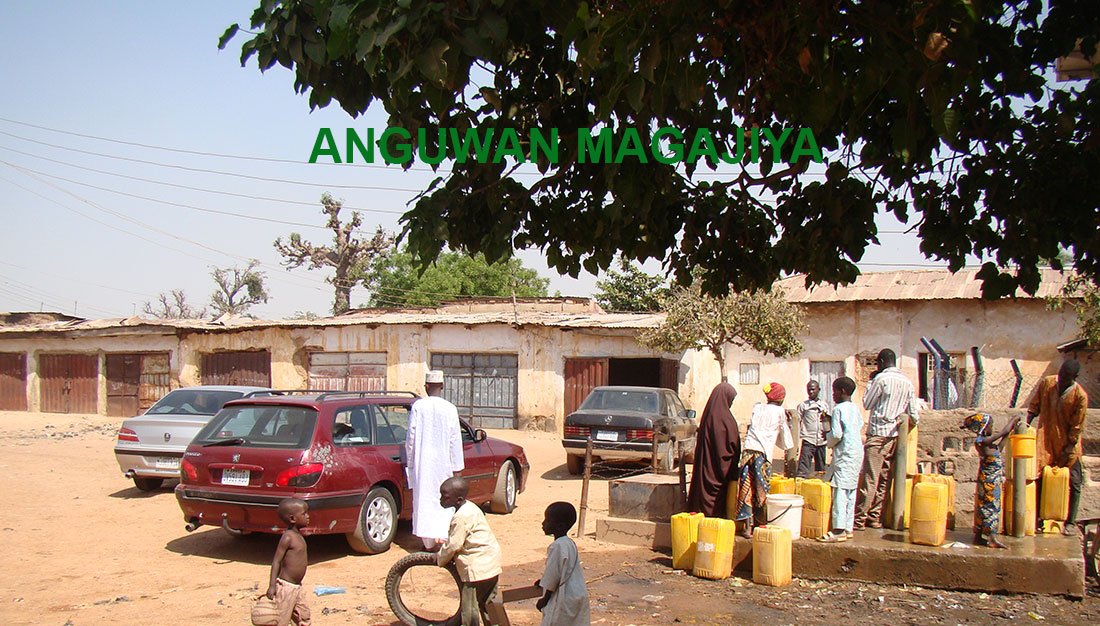
This ward is founded around the 15th century (Anguwan Magajiya), when the Birni was established. According to local traditions, Magajiya built a large compound on the site, which now belonged to the lineage of Madaki Sa’idu as her official residence. This house, which composed of some members of the royal dynasty, of the rulers of Zazzau up to the period of the Jihad. When the house came under the control of the Jihad leaders, Mallam Musa was reported to have given the house to the Mallawa ruling dynasty.
The establishment of Magajiya prompted the emergence of some other wards within its vicinity. These included: Anguwan Lalle, Anguwan Kahu and Magajin Aska.
According to local traditions, Anguwan Lalle was formed by a group of Sullubawa Fulani who came to Zaria under the leadership of a person called Abubakar. Little is known about the activities of these people except that they were mainly engaged in pastoralism and commerce. The traditions claimed further that very close to the settlement of these groups of peoples was a big henna tree known as lalle in Hausa. Located under this lalle (Henna) tree was a well, which the people used to water their animals. It was on account of this lalle (Henna) tree that the ward derived its name. Located to the north of the settlement of Magajiya close to Rafin Sarki was the settlement of local barbers (Wanzamai) known as Anguwan Magajin Aska. The history of this ward is traced to the 15th century when the royal family under Magajiya settled on the area. Following this development, the occupational groups of barbers also settled very close by. We do not know precisely why the group of traditional Barbers settled in the area close to Magajiya. It is plausible that as a highly respected occupational group, the traditional barbers were settled by the state on the site to make their services more accessible to the members of the royal families located at both the Palace and Magajiya. This may be as a result of their incorporation into the political affairs of the state following the realization of their role in the provision of health care services to the society. Parts of the services provided by this professional group included provision of medicine in cases of sickness, delivery, wounds and fractures and venereal diseases. They also performed barbing and circumcisions.
Closely located to Anguwan Magajin Aska is Anguwan Kahu. The formation of this ward was due to the tremendous expansion of Magajin Aska following the settlement of large groups of pastoralists. The earliest group of pastoralists to settle here traced their ancestry to Malam Ma’aji and his brother Ahmadu who were claimed to have arrived Zaria around the late eighteenth century from Kano. On their arrival to Zaria they were settled on a piece of land located along the Rafin Sarki. Due to the constant supply of water to the area at all times people came to refer to the site as Hancin kare.
Another prominent group of people that settled at Anguwan Kahu were the lineage of the Takarawa. The Takarawa were believed to have been the descendants of the Fulanis that fled from Kano as a result of the Jihad wars and settled in Zaria under the leadership of Malam Muhammad. They were believed to have moved into Zaria in 1806 where they stayed in the present ward of Magajiya. Malam Muhammadu, the leader of this people is believed to be highly knowledgeable and on account of this he was referred to as Takaru and consequently his lineage was named Takarawa.